Move the cursor around the map to find links or select another year from the buttons below.
)
)
)
)
)
)
)
)
)
)
)
)
)
)


)
)
)
)
)
)
)
)
)
)
)
)
)
)
Pressing F11 on your keyboard will open this page out to full screen size to fascilitate easier viewing. Press F11 again to restore.
If your internet browser does not have JavaScript enabled, or the changing maps do not display, then click here for an alternate view of the maps on separate pages.

All the maps on these pages were "hand drawn" on the computer (!) with the Paint Shop Pro image editing programme. I've chosen certain years which best demonstrate Coventry's development.... the reasons for their inclusion, and the sources used, are explained here:
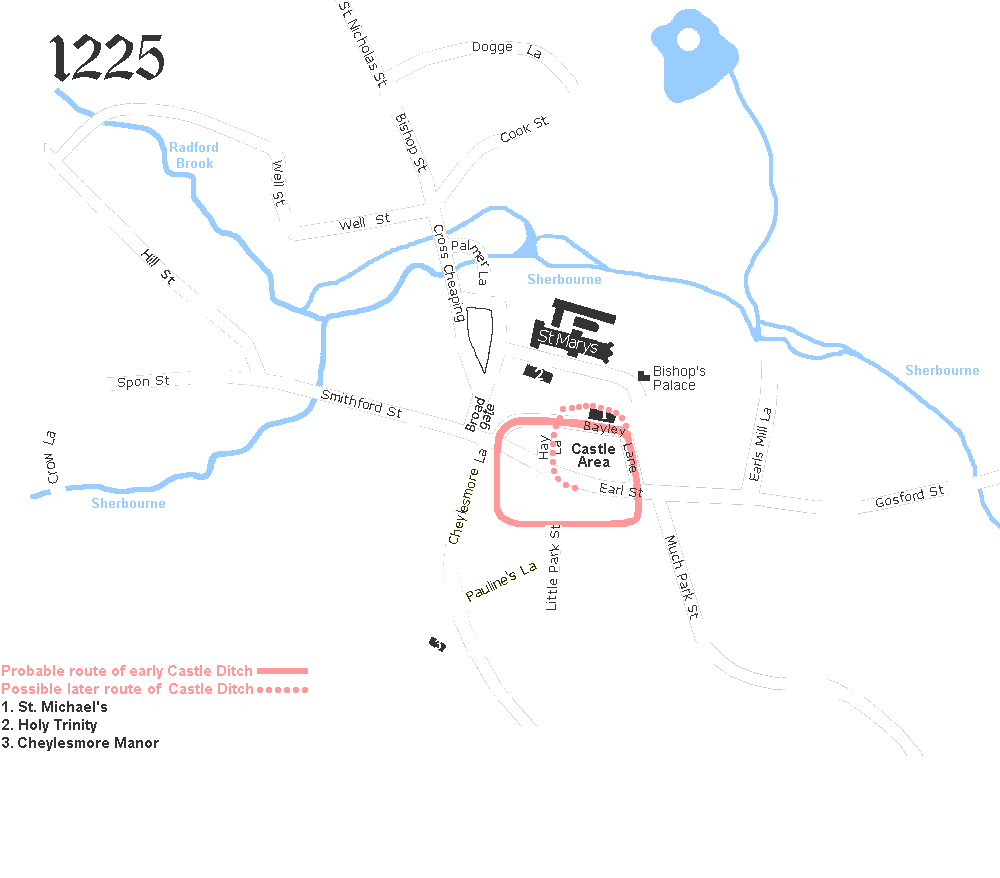
- I've created the maps of 1225 and 1400 myself using information available; e.g. lists of property deeds and lists of streets where traders lived in medieval times. It can be clearly seen how by 1225 the shape of the fledgling town was developing, and by 1400 the street pattern was set, and would alter very little over the next few centuries - many such streets still being in existence during the 20th century. The layout of the castle grounds is based upon descriptions given in the Victoria County History of Warwick, Volume VIII, 1969 and David McGrory's A History of Coventry, 2003.
- The 1610 map is by John Speed, reproduced from an engraving made by W. Hollar for Dugdale's "Warwickshire", 1656. It was the first proper plan made of our city. Compared with the plan of 1400, it shows that no major changes were made in Coventry over the preceding three centuries.
- The map of 1749 is based on a plan of the City of Coventry, Surveyed in 1748 & 49 by Samuel Bradford and engraved by Thomas Jefferys, published in 1750. Here we can see the beginning of some infilling of new streets within the city.
- By 1807 it's notable in that no new streets had been built in the preceding six decades. The information is from Thomas Sharp's map of Coventry, reproduced from an engraving by J. Roper, made under the direction of E. W. Brayley to accompany "The beauties of England and Wales".
- The sudden expansion seen in the "Board of Health Map" made in 1851, then an even more rapid expansion of streets by 1869, in the map produced by City Surveyor, E. J. Purnell, especially for Benjamin Poole's huge history, clearly demonstrate the huge impact of the industrial revolution. (See below *.)
- By the "Baedeker Town Plan" of 1900 it appears that all the expansion possible had been completed - Coventry's city centre was just about full!
- The changes by 1937 (based around the 1936 "Hill's Guide and Street Plan") appear more subtle, but the building of Corporation and Trinity Street (1931 & 1937) usher in the beginning of 'modern Coventry'. Significantly, for the first time in Coventry's history, building new roads has meant the destruction of old ones. Large sections of the River Sherbourne were also culverted during this time - a sad loss to the appearance of our city centre.
- The 1951 Ordnance Survey large scale Street Plan of Coventry shows the start of post-war reconstruction with the first section of the new Precinct leading into Broadgate Island, and more of the River Sherbourne being culverted in preparation for Fairfax Street. Largely speaking, very few noticeable alterations have occurred since before World War Two. Things are about to change dramatically....
- By the time the 1968 Geographia Street Plan was drawn, Coventry had seen the Precinct fully pedestrianised, with plans to pedestrianise Hertford Street about to materialise, the building of a 'New' Union Street, Fairfax Street, Manor House Drive plus others, and dozens of old streets soon to completely disappear under the Inner Ring Road which was nearing completion (1974). It will soon, however, give traffic a free flow around the city centre, relieving central congestion.
- By 2000, the Geographers' A-Z Map shows that many more alterations have been made, mostly to aid the flow of traffic, but some the requirement of new shopping schemes - the saddest being the destruction of the still new Broadgate Island for the sake of the Cathedral Lanes shopping centre and its tent!
- 2018 still sees some tinkering with streets around the city centre, although nothing major. Broadgate is pedestrianised, the London Road/Parkside area gets a new roundabout layout and the Hales Street/Pool Meadow junction is redesigned to allow buses beneath the Whittle Arch.
* It is interesting to note the rate of growth of the Coventry streets during the 1800s. For the preceding five hundred years there were few major changes, but during the industrial revolution of the 19th century, the number of streets in the centre of the city more than doubled. This was mainly due to the building of factories, but this, in turn, created a necessity to house the thousands of people who flooded into Coventry to find employment, first of all in the weaving and watchmaking industries and then from around 1870 the cycle industry, which, owing largely to the brilliant inventor James Starley, spawned an astonishing 248 cycle firms in the city, making it by far the biggest bicycle manufacturing centre in the world. Many of these cycle firms would eventually turn to manufacturing motorcycles, then cars, and surprisingly, James Starley had a key role to play there too.... he invented the differential gear, the design of which has not significantly changed in modern day vehicles more than a century later.
As stated, John Speed's map of 1610 is the earliest 'official' map available. However, for the 1225 and 1400 plans, I have used information from books and various sources to work out which streets were in existence from two to four centuries earlier. The reason I specifically chose 1400 is because it was shortly before this time that Coventry's wall first encircled the town, therefore the streets leading in and out of the city were already well established, and both influenced, and were influenced by, the wall - the route of which, of course, was also determined in no small part by the River Sherbourne.
1225 was chosen as being an approximate time when many deeds and lists of traders existing in particular streets started to be recorded. It's only a rough guide to the possible street plan of that era, and it is known that some other lanes were named in various papers, but their position is uncertain. Many such lanes were perhaps a pathway to a prominent merchant's property, and would have only existed or carried the name for a short period.
It's also interesting to think about the buildings that existed in 1400. The preceding few decades had been a prolific era for Coventry; Whitefriars Monastery had only been founded six decades earlier, and St. Michael's church was still a work in progress, with most of the structure we now recognise only being added around that time. The same can be said for Holy Trinity church, and all three of these fine buildings would see more structural changes before settling into the shapes that we now recognise. Likewise, the building of St. Mary's Guild Hall had only begun sixty years earlier, and in 1400 was in the middle of a prolonged period of enlargement and development. Greyfriars church (now known as Christ Church) and Cheylesmore Manor House were already mature buildings, having been built over a century earlier. The Priory and Cathedral of St. Mary's was, of course, still a thriving and well established "industry", and must have looked an absolutely awesome sight dwarfing the other two churches. For this map, I have attempted to draw the priory as close to scale as I can judge to give a true impression of the relative size of the churches.

Website by Rob Orland © 2002 to 2025