
|
Index...
|
 n January 1329 King Edward III granted permission to the Prior and 'goodmen' of Coventry to collect taxes, specifically to fund the building of a protective "Town Wall". By that time, Coventry had built up some considerable wealth, was one of the four most important cities in England, and may have been considered a strategic target in times of war. Just like York in the north and Bristol in the south-west, Coventry could be regarded as the principal town of the midlands, and our city did indeed lay at an important geographical intersection, passed through by many travellers on their north-south journeys.
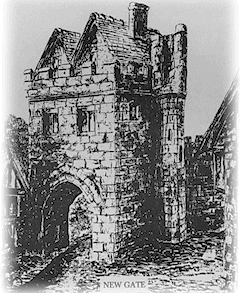 New Gate by Coventry artist, David Hale. (This image must not be copied or reproduced in any way without permission from the artist.)
It was well over two decades before building finally began on the wall; the first stone being laid by mayor Richard de Stoke at New Gate (the London Road entrance, pictured left). There is some uncertainty about the date of starting, with 1355 often being quoted (the year that Richard was voted in as mayor). However, one book of annals gives the date as 1356, and this seems more likely, as he wouldn't have taken office until Candlemas day (2nd February) the following year. Additionally, building projects generally did not take place during the cold winter months because the lime mortar would not set, so spring 1356 seems a plausible time for beginning such a project.
Although the circuit was reported in the City Annals to have been finished after forty one years, much repair work and re-routing of the wall was still to be carried out, and our defensive structure in its final form was completed 179 years later, in 1534, giving it a total circumference of 2 1/8 miles. At around eight feet thick, over twelve feet high and punctuated by twenty towers and twelve proud gates, it was reported by some to be the most impressive city wall in the country, equal to, if not greater than, that around London.
The tax collected was known as "murage" which is based on the Latin word "murus", meaning "wall". The initial request for the tax was for a period of six years, but the king's brother, John de Eltham (also the Earl of Cornwall) had this extended for a further two years in an attempt to avoid having to foot the bill, as he was due to succeed Queen Isabella as the Lord of Cheylesmore Manor.
Unsurprisingly, and something with which we're quite familiar in this modern age, the whole project was neither on time nor within budget!
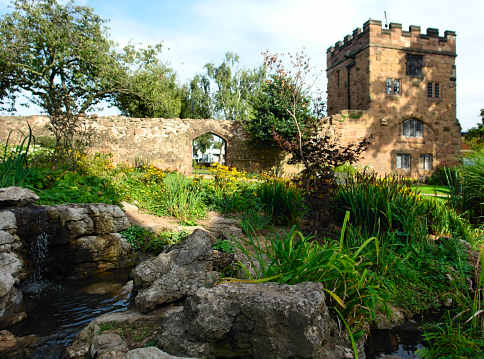
Sadly, the finished wall stood for less time than the total period taken to build it. In 1662 King Charles II ordered for the wall to be slighted (demolished), leaving only the gates intact. Similarly, the walls of Gloucester and Northampton plus Taunton Castle were also demolished, so Coventry wasn't uniquely 'picked on', although the places that were treated in this destructive manner had all supported the Parliamentarian cause.
It would seem at first glance that Charles' reason for this vengeful act was that our wall, amongst others, had kept his father (Charles I) at bay during the civil war just a few years earlier. Indeed, it would be surprising if the newly restored King didn't take a little pleasure in carrying out the destruction of the grand fortification that had been Coventry's pride for three centuries. However, there was in actuality some sense in his given reasoning - which pointed out that the very existence of such a wall was likely to attract trouble or rebellion from anyone who in future might wish to make a stand against the monarchy.
The Earl of Northampton was given the task of destroying our wall, and with the aid of a reported 500 men, demolition began on the 22nd July 1662. The work took approximately three weeks; the Earl and his men being lavishly entertained and housed in the city during this time. It seems that he received no hostile reception for carrying out this sombre deed!
Once again, this lack of hostility on the part of the Coventrians might appear surprising. Two possible reasons come to my mind which might support this lack of reaction to our wall's demise.... firstly, after several years of Civil War and upheaval, the people of Coventry might not have had the energy left to make a fuss. Secondly, I think it's also possible that after many years of being burdened with the heavy taxes required to pay for the constant rebuilding and repair of the wall, it came as some relief to see the end of it. However, I must stress that this is only an opinion formed by myself based on what I have read, and I obviously have no way of knowing the true feelings of the people of Coventry at that time.
Taxation wasn't the only burden that the wall brought to the people within. Anyone whose property backed onto either the wall or the surrounding ditch was made responsible for their section. The ditch constantly required cleaning, and many fines were levied against folk who were found tipping rubbish or 'human waste' into it!

Website by Rob Orland © 2002 to 2026
